
24 hour bimbofication
my horse girl childhood, looksmaxing, and my great grandma

As I write this, I am currently a Sugared + Bronzed Level 3, a fake tan level that the salon associate assured me would be more cool-toned and comparable to if I had spent about a week in the sun on vacation. While I stood in only my underwear getting hosed down with a coconut-scented product by a beautiful woman with baby bangs and perfectly manicured eyebrows, who made light small talk and professionally ignored my nudity, I thought about the idea that for some women this treatment was old-hat and maybe even a chore. I saw them in the lobby. For me, this was brand new and exciting… as are a lot of girly things that I’m trying to make part of my life, like manicures and withholding emotionally from men.
This morning I went to put on my Ugg boots to take a walk and found the view in the mirror to be unsettling and jarring, with my blonde hair, my lack of tattoos. Without my knowing, it’s like I’ve slightly transformed into the type of woman I idealized when I was a little girl. My skater cousin’s hot girlfriend with her Christina Aguilera highlights and clove cigarettes, my old babysitter who had ultra-thin eyebrows and Britney Spears CDs in the glove box of her silver hand-me-down Toyota, the neighborhood girl who rolled her softees and smacked gum in her mouth.
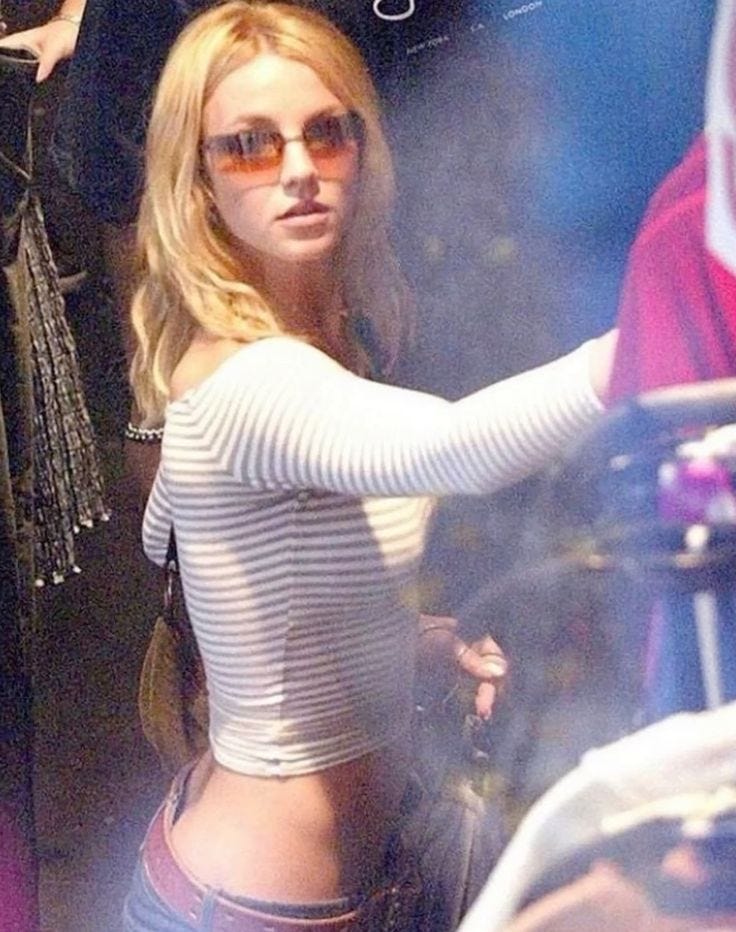
There was a time where I was so adamantly “not like other girls.” I grew up with three little brothers and tough kids in the countryside, where it was unacceptable to be the weak, bookish type that I was. There was no tolerance for the things that I liked—namely, magic, horses, vampire and My America books, fruit-scented lip glosses, the idea of keeping a diary, and drawing. Everything I loved I had to keep private because I was made to feel I was embarrassing. And tbh, yes, it is embarrassing, but almost everything is—and nothing was so bad it warranted the hiding and the shame. The bookish-ness of my childhood developed into an edgy hipster-y teenhood, furthering along this rejection of a part of myself that felt imaginative and fun. What was so embarrassing about myself, I realized later, is that I am so Female.
I suppose at this point it’s difficult to say something elegant and fresh about the commercial, imposed nature of the-mode-of-being our broader capitalist culture considers feminine. Yes, it’s like, to be a woman, buy this outfit, do your hair this way, get into pilates, wax, pluck, inject, spend $ and time on your beauty maintenance, wear painful shoes, always check and double-check in the mirror. Comport yourself a certain way, do these ten things to keep your man, diet, stay slim, don’t show weakness, submit, do it with ease, destroy, smile. This aspect of the culture feels markedly worse online today compared to the self-love, independence, and sexual freedom of the unshaved 2010s. I don’t know how anyone watches TikTok. When I do, or at least before my algorithm is meticulously shaped into showing me silly puppy content, it’s video after video of: here’s an exercise that will snatch your waist, you’re putting on bronzer the wrong way, here’s a shirt you have to buy, here’s so-and-so’s routine, you’re doing this wrong, you’re doing everything wrong, we have ten seconds before you’re going to be in the permanent underclass, buy this, buy that, get, consume.
If I will be so honest with you, I’m not in a southern belle social circle with rigid gendered expectations about make-up, behavior, dieting, and how to treat a man. It was only ever slightly like that in my childhood, and easily rebelled against. I’m like 30. The idealism ingrained in me is that women are supposed to be self sufficient, smart, and strong, and admired for something other than their beauty. It leaves a bad taste in my mouth today to see people espouse the opposite—the “I’m just a girl,” posts, the tradwifery and pronatalism stuff. Although I suppose some of it is in jest (and trust, it is so fun to tell some random loser “men used to go to war”), and some of it is just the fantasy of wanting to be a layabout without the heavy responsibility (and hard work) of standing on your own two feet in this economy. There’s this sense that women have been robbed of the choice between submitting to their husband versus submitting to their boss.
For a lot of young people right now, the main line of thinking is that if you are attractive enough, you can coast by. When a woman is beautiful enough she can just marry someone wealthy to take care of her forever. When a man is beautiful enough, he will be taken seriously, and thus make so much money that he won’t need anybody, and can surround himself with a harem of beautiful, interchangeable biddies. Life is just easier for people who are fit and look perfect, allegedly. This is an ideology that has sprung out of 4chan inceldom, directly, and is increasingly becoming more and more accepted in the mainstream. Which brings us to looksmaxing, clavicular, and skinni society.
Looksmaxing correctly diagnoses the superficiality of our culture. Attractive, powerful people get preferential treatment. However, it reaches the wrong conclusion, and submits to that superficiality, by calling for us to conform to unfair ideals. Looksmaxing says sacrifice your body on the burning pyre of fleeting beauty. Get the surgeries at the cost of your self-esteem and your ability to accept your, and other people’s, imperfections. Harm yourself with drugs, eating disorders, and vicious routines. Take a hammer to the jaw. Do not go deeper than skin deep. Skin is all there is.
Looksmaxing wants you to reject the idea that all people are inherently beautiful, just as they are.
It saddens me because it is such a turn. It feels like the last handful of decades have been a fight against the deeply sexless perfectionism of the 1950s, a fight that has opened new avenues for self expression—deeply important aspects of self expression, like one’s gender, one’s sexuality. Looksmaxing says: why would you ever want to be yourself?
OK, where is my line of thinking going? Oh yeah. My fake tan and my weird bimbo look right now factor into this somehow, and that’s the part I’m trying to figure out. Maybe I am looking to justify my beauty routine and the things I do that are markedly not feminist. I do not have the lipstick-feminism brain damage that would make me think “I’m doing this for MYSELF actually!”
I also do not have the Dworkin radical feminism brain worm that insists everything feminine is inherently degrading or oppressive. (Please don’t kill me for saying this, but it was easier to jump from the sort of right-wing atmosphere of my childhood into radical feminism*, because they shared the underlying basis: that women are weak, with low agency. The difference being whose fault that is: women themselves, or the patriarchy.
*Which happened for me around age 14.)
With maturity, I land more and more on ambivalence and pragmatism. My life has unfolded in various ways that has made various truths easier to accept, and other things easier to disregard. To narrow it to something I can talk about, it’s easier here to fixate on beauty.
And I think I end up in the carefree camp of Dolly Parton’s conception of beauty, for no reason other than that it feels true. I love the artificiality and self-invention of her beauty, and the paradox of authenticity it creates. The Dolly Parton type of beauty comes from this loose school of thought, you know, and excuse my heteronormativity, that if women were really doing all this for men, we’d be walking around naked—so of course, this is for other women.
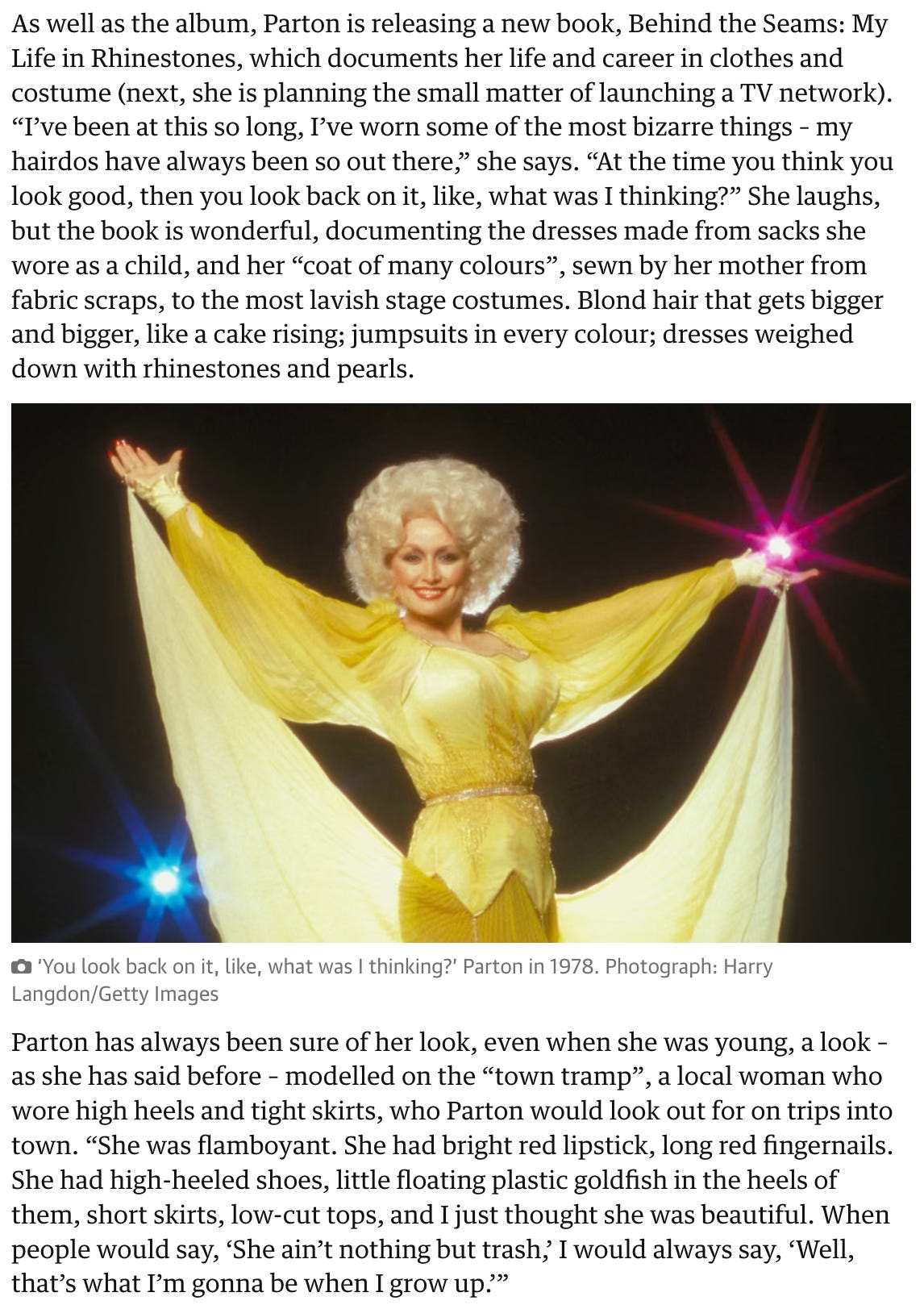
There’s some staying power for me about how ancient beauty practices are. For thousands and thousands of years we’ve worn makeup. There is something precious to me about the idea of civilizations inventing their own ideals of beauty and striving toward them—it’s not so superficial. Beauty can be creation, a demonstration of wit and the inventive human spirit. I find beauty to be close to divinity. God made all that is beautiful.
I think it’s okay to just admit that we are not immune to certain social pressures, and that sometimes you participate in beauty rituals because it makes you feel cool or hot. And it’s probably better to participate in the beauty routines that feel FUN versus the ones that make you feel lowkey suicidal because you’re doing them to maxx-anything. Max’ing feels so transactional and doomed, like you’re making a bargain of your body in exchange for status. It’s such a resentful process. Clavicular, who I love like a puppy - who, I see myself in, sometimes - does not seem to be having fun. He’s like strapped into a roller coaster headed into hell.
Womanhood factors into whatever the hell I’m talking about. The specter of Betty Draper and the type of womanhood she represents hangs over me in a particular, touching way. There were many Betty Drapers in my life in the early 2000s—the women of my grandmother’s and mother’s generation who raised me, whose presence was perhaps even more foundational and formative than the Britney Spearses of my neighborhood, with their sparkly belly button rings and boyfriends all named Trent. Yet these women stood next to each other, suffered the same under the patriarchy, under capitalism, and also could be powerful in the same way.
There is such a thing as a distinctly female type of power, and it’s not our fault that we live in a culture that both devalues and refuses to acknowledge that power. It doesn’t mean it’s not there, or it’s not valuable. In the Jungian sense (note: we all have some balance of feminine and masculine energies within us), it’s the feminine archetypes that foster growth, creativity, and emotional connectivity. The feminine is courageous and self-reliant - it can be selfless, magnetic, and intuitive. There is no world that can center just on the masculine alone because the masculine lacks this centering - not to be on a Paglia beat, but he is outcast from her, and must strive to find his place. For myself, as a painter and a writer, I am particularly focused on the creative capacity allowed by the feminine, and how it arises and is fostered.
Now I understand. My great grandmother used to say, somewhat cryptically, “Women do not understand what they’re giving up.” I think probably in reference for women wanting equal rights as men, which was misguided for her to say. My great grandmother was not a submissive woman. She was strong, spiritual, outlandish, brave, and funny. She’d run into a house fire. She was an antique dealer for part of her life, and she was beloved at her job as the Astor hotel. I’d hear similar sentiments about the soft power of women and the weakness of men from my grandmother, who only later in life would lament, “I’m just a cooker, cleaner, washer, scrubber.” She wanted her granddaughters to shoot for the stars. I certainly did not think of my grandma as a cooker, cleaner, washer, scrubber. She steered the whole family, ran a business, and made sure each and every one of us was well-educated and well-dressed. She was a force, a gentle force, but a force. Elegant, stubborn, loving, and smart.
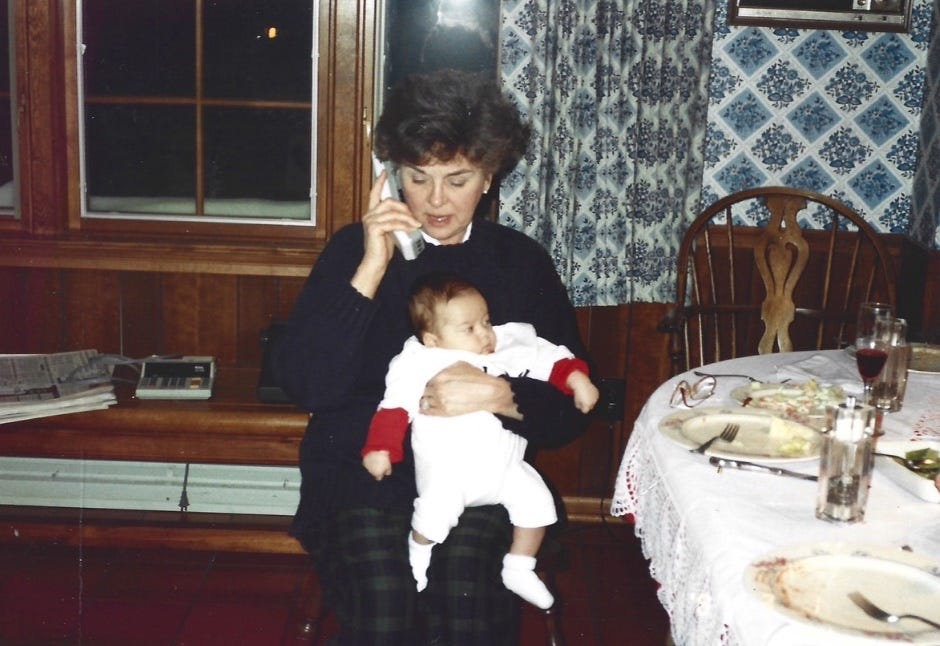
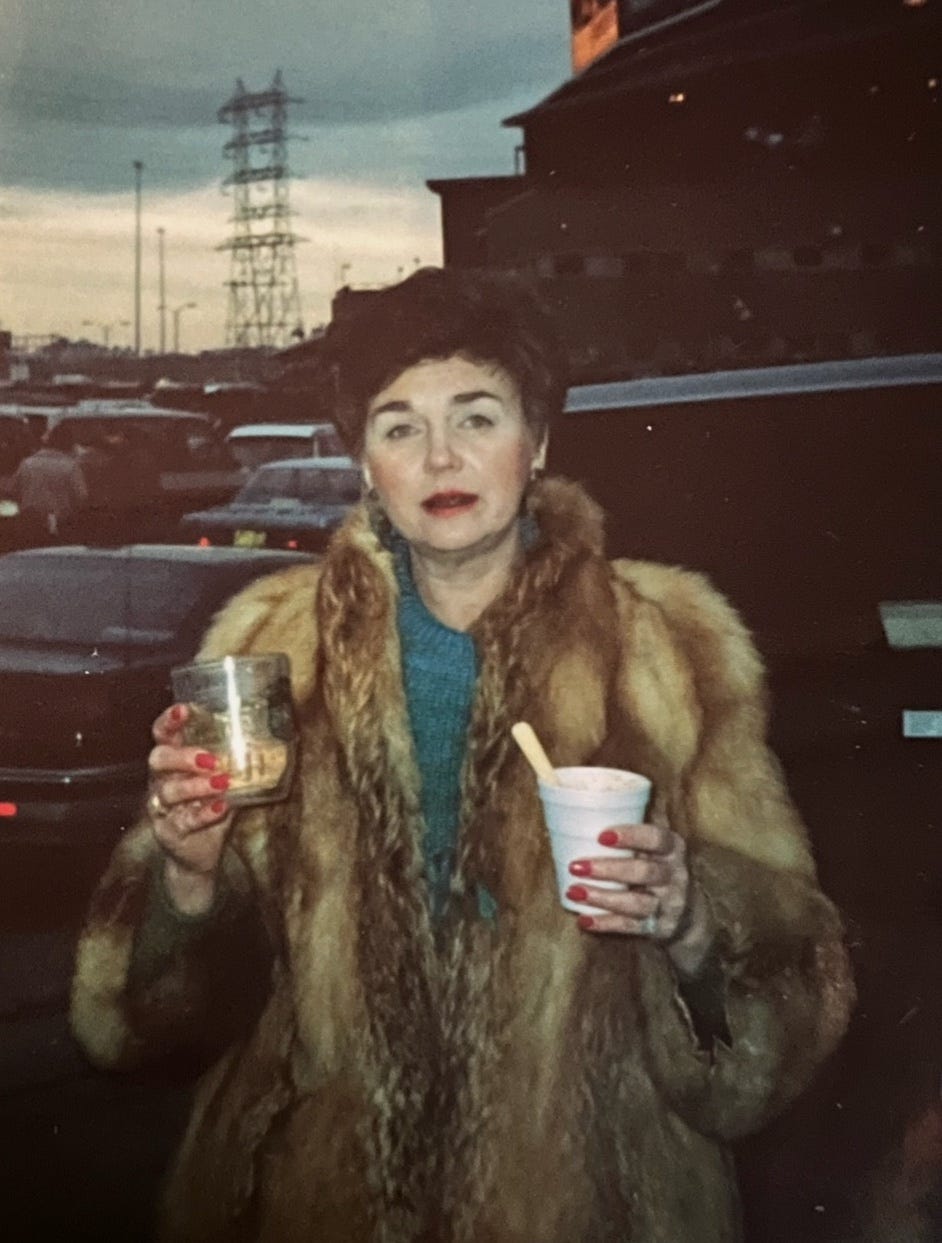
The women in my family had a type of power within our family that seemed to outweigh the men, who orbited us and them. The men went off to jobs and brought home money, they sat at the head of the table, they drove the car on long distance trips. They certainly spoke louder and could be firmer. But the children in the family could see who was making the decisions and who controlled the atmosphere.
I think the women understood this, but the cultural narratives of their powerlessness were ultimately really hard to reject. Hence the cooker, cleaner, scrubber comment. I hope grandma knew in her bones she was really much more than that.
I wonder sometimes if the Whitney-Lynns and Courtneys of my childhood found a way to get a footing like the Bettys of my life. It was certainly something watching one of them wrap a hapless teenage boy around her finger, or confront a demanding manager at the mall, to walk the mile instead of run it, talk back to the teacher. These were not the kind of girls I was friends with, but I’d sometimes find myself at a rare party with them, and understood they had snuck out a window to be there. They were the chaotic cthonic, like it or not, and they always knew better than Daddy or Brad. I wonder if their spray tans and fake nails made them feel like they were doing something intentional with their image, versus trying to look like a girl on the Sports Illustrated magazine cover.
The party girls rebelled and I admired them. Yet I became the type of girl who became pale and vaguely vegan, who rode my bike everywhere, did the readings for class, went to local concerts, and didn’t speak unless it was to be sarcastic. I think, yes, because I loved it, I love Twin Peaks and loser noise music. But I also think I was ashamed that I found girliness to be alluring. Because of that shame, I missed out. I was tightly wound and inexpressive, afraid.
And now I’m like:
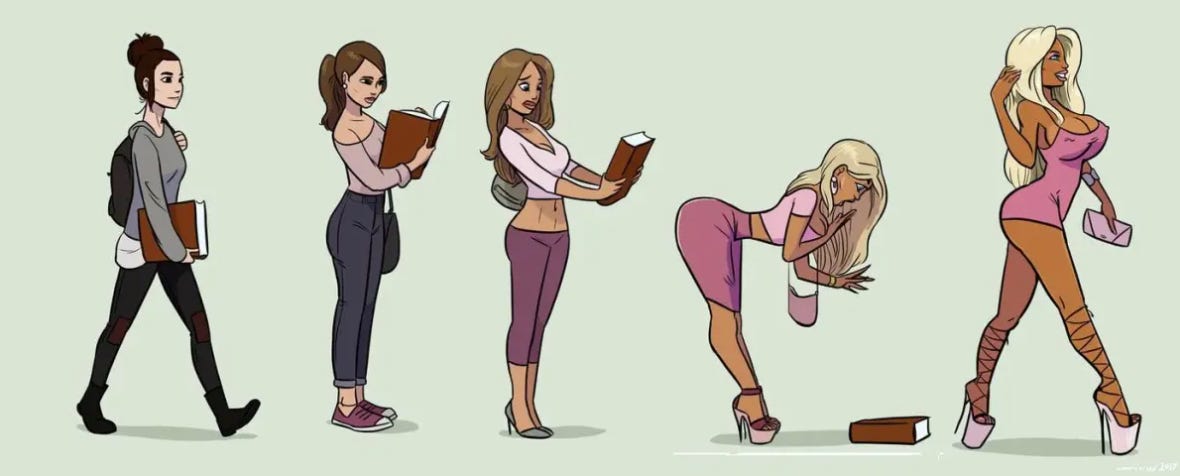
Because beauty isn’t just about being attractive to the opposite sex, and it also isn’t about power. I think it has more to do with joy and embracing one’s own desires (supplanted or not), if not one’s inherent nature.
In conclusion, we should all have more fun. Beauty is not inherently superficial but a vital mode of self invention. And the force of feminine power should be harnessed (by us) and reckoned with (by them).
Stunning piece, perfectly stated!!!
Yes yes it’s freeing to acknowledge that not every action we do has to be labeled feminist simply because we want to justify it. We just participate in a flawed system.